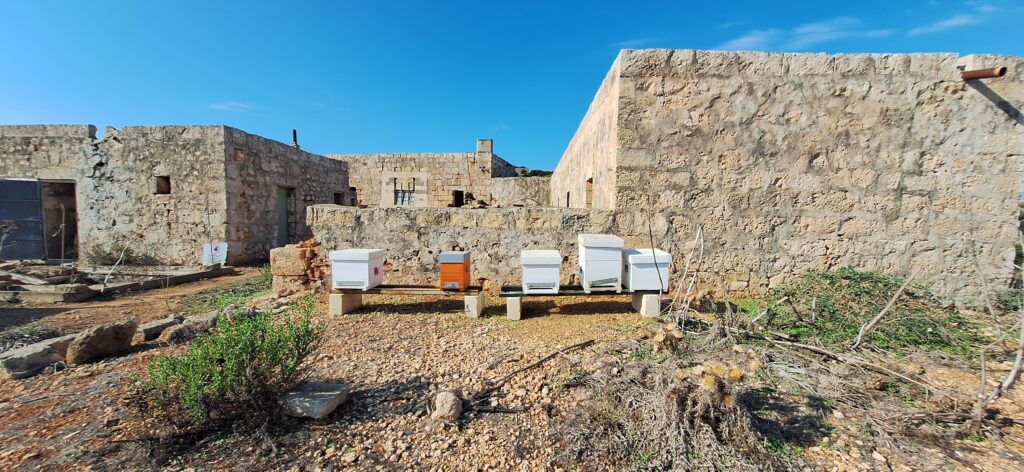
The launch event of Cross-Heritage took place today. Cross-Heritage is a project co-funded by the European Union under the INTERREG Italy–Malta Programme, whose Managing Authority is the Sicilian Region and whose Lead Partner is Fondazione Messina. The project partners are Fondazione Horcynus Orca for Sicily and MRDDf and FoEM for Malta.
The project aims to enhance, in a concrete, structured and sustainable way, two territories of significant natural, historical and cultural value located within Natura 2000 areas, while co-designing a methodology that can also be replicated elsewhere. These territories are Capo Peloro in Sicily, Messina – the Charybdis of Homeric mythology – and Comino in Malta. Although located close to highly popular tourist destinations, such as Taormina in Sicily and the Blue Lagoon in Malta, both territories remain largely outside established tourist routes. Visitor pressure is concentrated in a few fragile locations, while nearby natural and cultural heritage assets remain relatively unknown and underutilised.
For this reason, Cross-Heritage establishes two interconnected heritage hubs and a Cross-Border Cluster, developing regenerative tourism experiences and a non-profit management model that contribute to the sustainable enhancement of the Capo Peloro and Comino territories.
Cross-Heritage addresses this challenge by transforming lesser-visited heritage sites into interconnected, inclusive and learning-oriented destinations. The hubs are Parco Horcynus Orca in Capo Peloro and Il-Forn ta’ Kemmuna in Comino. Together, they form a Cross-Border Heritage Cluster, offering joint initiatives and an integrated range of experiences linked to natural, cultural and gastronomic heritage.
The project develops on-site interpretation trails and tools, digital content and immersive environments, alongside a shared strategy for regenerative tourism experiences. The objective is to guide visitors to these areas of the two islands towards lesser-known locations, encourage responsible tourism practices and contribute to the protection of biodiversity and ecological balances. All activities are carried out in compliance with existing protection frameworks and promote the active involvement of local communities.
Cross-Heritage will also define a cross-border non-profit governance and management model designed to ensure the long-term sustainability of the hubs and make the experience replicable in other territories with significant heritage assets and in Natura 2000 areas.
The project targets local and regional public authorities; environmental agencies; managers of cultural and natural heritage sites, infrastructure and services; associations, NGOs and civil society organisations; schools, training centres, universities and research institutions; small businesses, producers, fishers, hospitality providers and tourism service operators; as well as local communities and visitors in the territories involved.
Tourists by Choice, Not by Chance. Main Activities
- Activation of Parco Horcynus Orca in Capo Peloro and Il-Forn ta’ Kemmuna in Comino as heritage hubs and learning spaces;
- Development of the Cross-Border Cluster, with joint programming and community-oriented initiatives;
- Creation of trails, interpretative materials, digital access points and a joint pilot action for immersive heritage interpretation, through the creation and enhancement of immersive environments;
- Development and testing of a shared regenerative tourism strategy and three pilot itineraries tested across the two territories;
- Definition of a cross-border non-profit model for management, governance, sustainability and replicability, adopted by the partners. At least four organisations will continue cross-border cooperation after the project ends.
Nature, Beauty, Culture, Tradition and Gastronomy. Expected Impact
The project aims to enhance valuable areas that currently attract fewer visitors, offering alternative visiting experiences and helping to redistribute tourist flows away from the main tourism hotspots. The trails, interpretative tools and immersive experiences are designed to improve understanding of natural, cultural and gastronomic heritage and encourage responsible behaviour in environmentally sensitive areas.
In the medium to long term, the non-profit model and replication activities are expected to support the lasting management of heritage assets, generate social, environmental and economic benefits for local communities, and foster continued cooperation among at least four partners beyond the project’s duration. The adoption or transfer of a joint solution by at least one organisation outside the partnership is also envisaged.
Sicily–Malta: Cooperation Addressing a Shared Challenge
Cooperation between Sicily and Malta makes it possible to address a common challenge: intense tourism pressure concentrated in a limited number of hotspots, alongside the insufficient enhancement of nearby areas of high natural and cultural value. Capo Peloro and Comino share the Natura 2000 protection framework and feature complementary ecological, cultural and gastronomic heritage. Joint action makes it possible to test approaches consistent with conservation requirements and develop an integrated tourism offering across the two sites.
The partnership brings together Sicilian expertise in cultural regeneration, hub management and immersive technologies with Maltese experience in conservation, ecological monitoring and Natura 2000 site management. Cooperation also builds on the historical ties between Sicily and Malta – including food, maritime and fishing traditions – and enables the joint development and testing of solutions that can be transferred to other protected territories.
Associated Partners
- Slow Food Messina APS
- Agència de Residus de Catalunya
- University of Messina
- Pro Loco Capo Peloro APS
- Majjistral Nature and History Park
- BirdLife Malta
- Din l-Art Ħelwa (DLH)
The content of this publication is the sole responsibility of the beneficiary and may not necessarily reflect the official position of the European Union.